From Foothills to Summit
Kilimanjaro Climate Zones & Vegetation
Five Distinct Environments on One Mountain
Climbing Kilimanjaro takes you through five remarkable climate and vegetation zones, from cultivated foothills and humid rainforest to heath, alpine desert and the arctic conditions near the summit.
The Mountain Changes as You Climb
The Five Climate Zones of Kilimanjaro
One of the most remarkable parts of climbing Mount Kilimanjaro is how quickly the landscape changes. As you gain altitude, fertile foothills give way to humid rainforest, open heath and moorland, barren alpine desert and finally the cold, exposed summit environment.
Climate zones are not fixed lines on the mountain
The altitude ranges shown below are approximate. Vegetation and climate boundaries vary between the northern, southern, eastern and western slopes because rainfall, exposure and local conditions are different around the mountain.
The higher you climb, the air becomes colder and drier, vegetation becomes increasingly sparse, and the effects of altitude become more important.
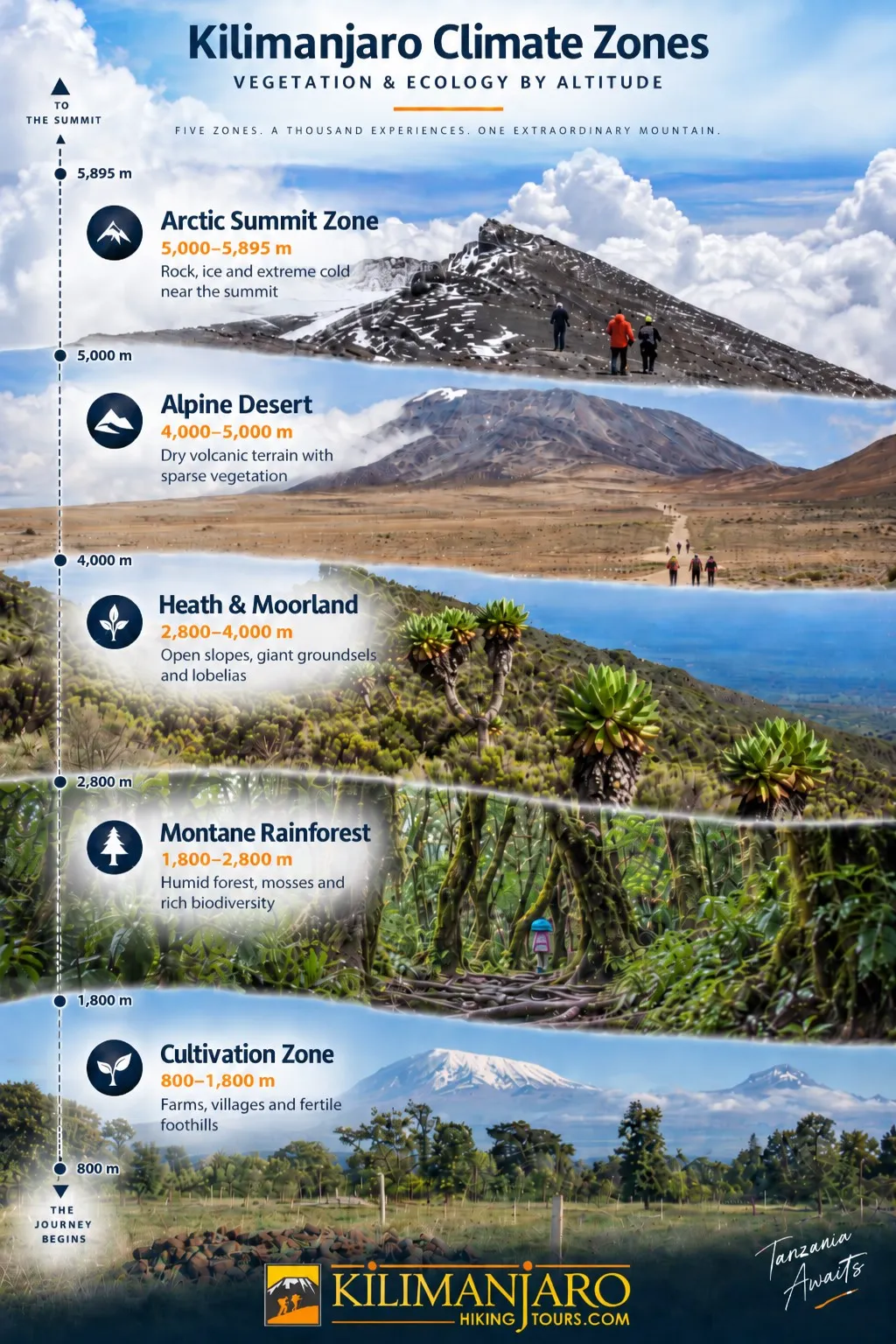
Kilimanjaro's ecological zones gradually transition into one another, so exact altitude boundaries may vary by route and side of the mountain.
Lower Mountain Zones
From Cultivated Foothills to Rainforest
The lower slopes of Kilimanjaro are the greenest and most fertile part of the mountain. Climbers begin below the national park in cultivated landscapes before entering the dense montane rainforest that surrounds much of Kilimanjaro.
Zone 1
Cultivation Zone
Approximately 800–1,800 m
Kilimanjaro's lower slopes are warm, fertile and heavily influenced by human settlement. The volcanic soils and relatively high rainfall support farms, villages and extensive cultivation.
Coffee, bananas and other crops are grown across these foothills. For most climbers, this landscape is experienced while travelling from Moshi towards the national park gate rather than during the main trekking days.
Zone 2
Montane Rainforest
Approximately 1,800–2,800 m
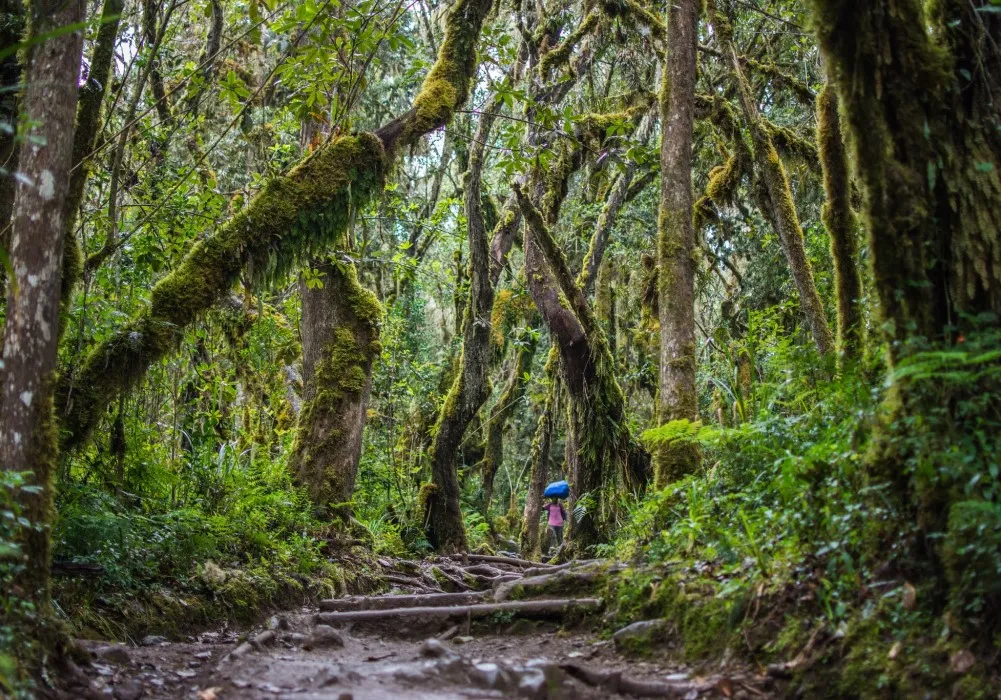
Above the cultivated foothills, the mountain enters a lush belt of montane rainforest. This is generally the wettest ecological zone on Kilimanjaro, with dense vegetation, moss-covered trees, ferns and a noticeably humid atmosphere.
The forest helps capture moisture from clouds moving across the lower slopes. Trails can be damp or muddy after rain, while the canopy creates a very different environment from the exposed landscapes higher on the mountain.
The rainforest often feels surprisingly warm at the start of a climb. Waterproof layers should remain accessible, even when the weather looks clear at the trailhead.
Zone 3
Heath & Moorland
Approximately 2,800–4,000 m
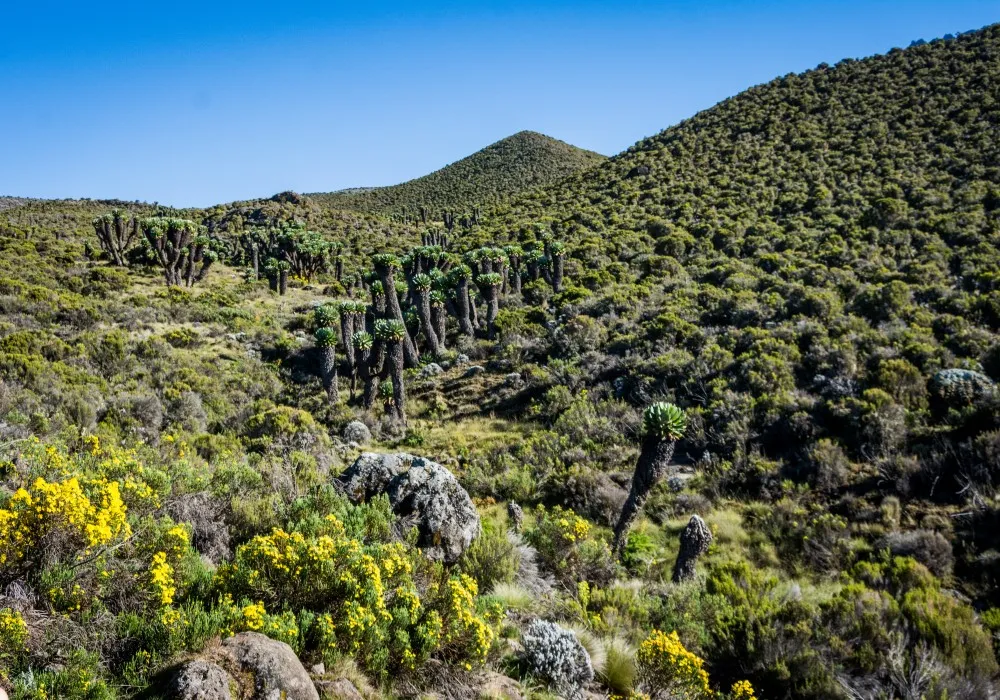
As the rainforest thins, Kilimanjaro opens into the heath and moorland zone. Trees become smaller and more scattered, while grasses, heathers and unusual high-altitude plants begin to dominate the landscape.
This is where climbers often encounter some of the mountain's most memorable vegetation, including giant groundsels and lobelias. These plants are adapted to strong sunlight, cold nights and the large temperature changes that occur at higher elevations.
The terrain also becomes increasingly exposed. Views widen, the canopy disappears and Kilimanjaro starts to feel much more like a high mountain than a tropical landscape.
This is often the point where layering becomes much more important. Conditions can feel warm in direct sunshine, but temperatures drop quickly when clouds move in or the sun goes down.
Zone 4
Alpine Desert
Approximately 4,000–5,000 m
Above the moorland, Kilimanjaro becomes noticeably harsher. Vegetation rapidly disappears and the landscape changes into a cold, dry alpine desert dominated by volcanic rock, gravel and exposed mountain slopes.
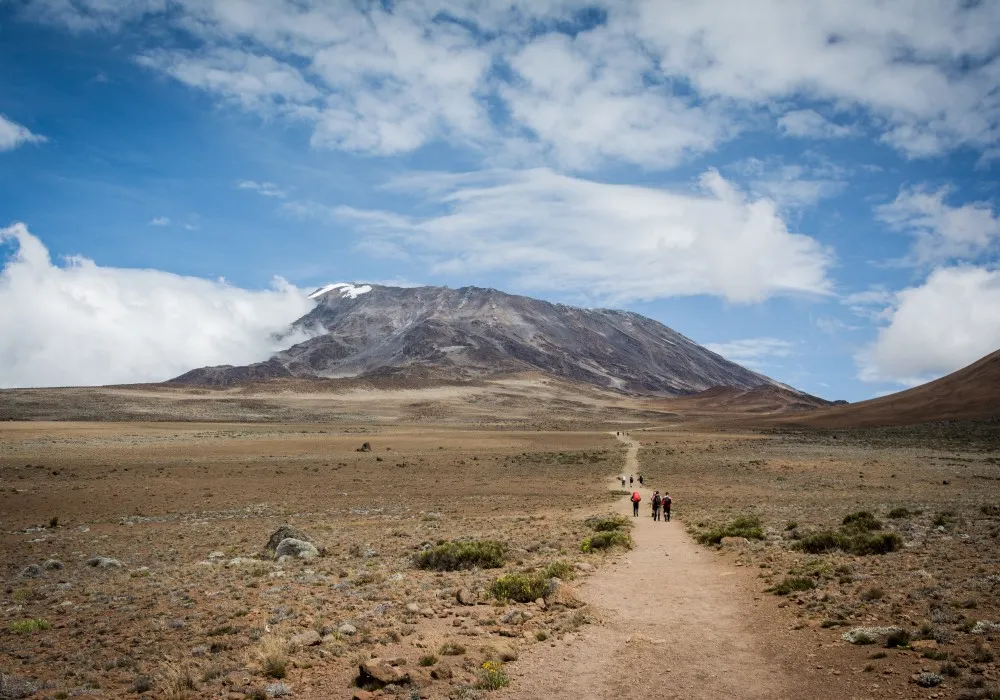
Conditions in the alpine desert are too severe for most vegetation. Rainfall is lower, the air is drier and plants that survive here are generally small, scattered and highly adapted to the exposed environment.
The lack of vegetation also makes the terrain feel much more open. Climbers cross broad volcanic slopes, rocky ridges and exposed valleys with very little shelter from wind or direct sunlight.
Temperature differences can be dramatic. Strong sunshine during the day can make conditions feel surprisingly warm, while temperatures fall quickly in the evening and overnight.
This is where the mountain begins to feel truly high-altitude. The scenery becomes stark, breathing becomes more noticeable and climbers increasingly rely on warm layers, sun protection and a steady, controlled pace.
Zone 5
Arctic Summit Zone
Approximately 5,000–5,895 m
At the highest elevations, Kilimanjaro enters an extreme environment of exposed rock, scree, snow and ice. Vegetation virtually disappears as climbers approach the crater rim and Uhuru Peak.
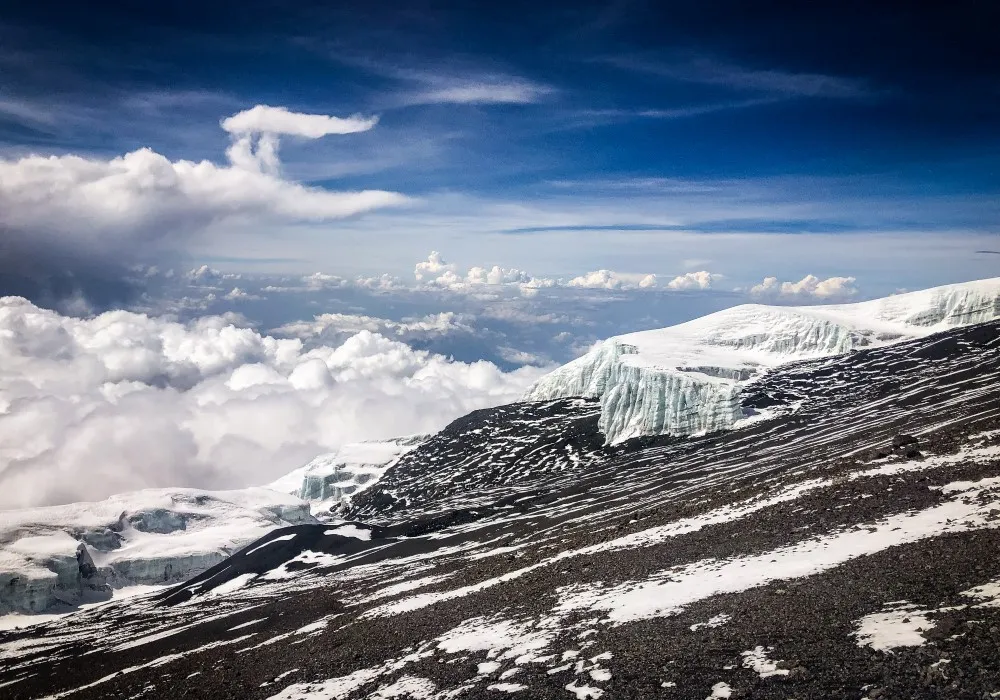
Kilimanjaro's highest ecological zone is dominated by exposed rock, scree, ice and, depending on conditions, snow. Temperatures are considerably lower than on the slopes below and plant life is almost entirely absent.
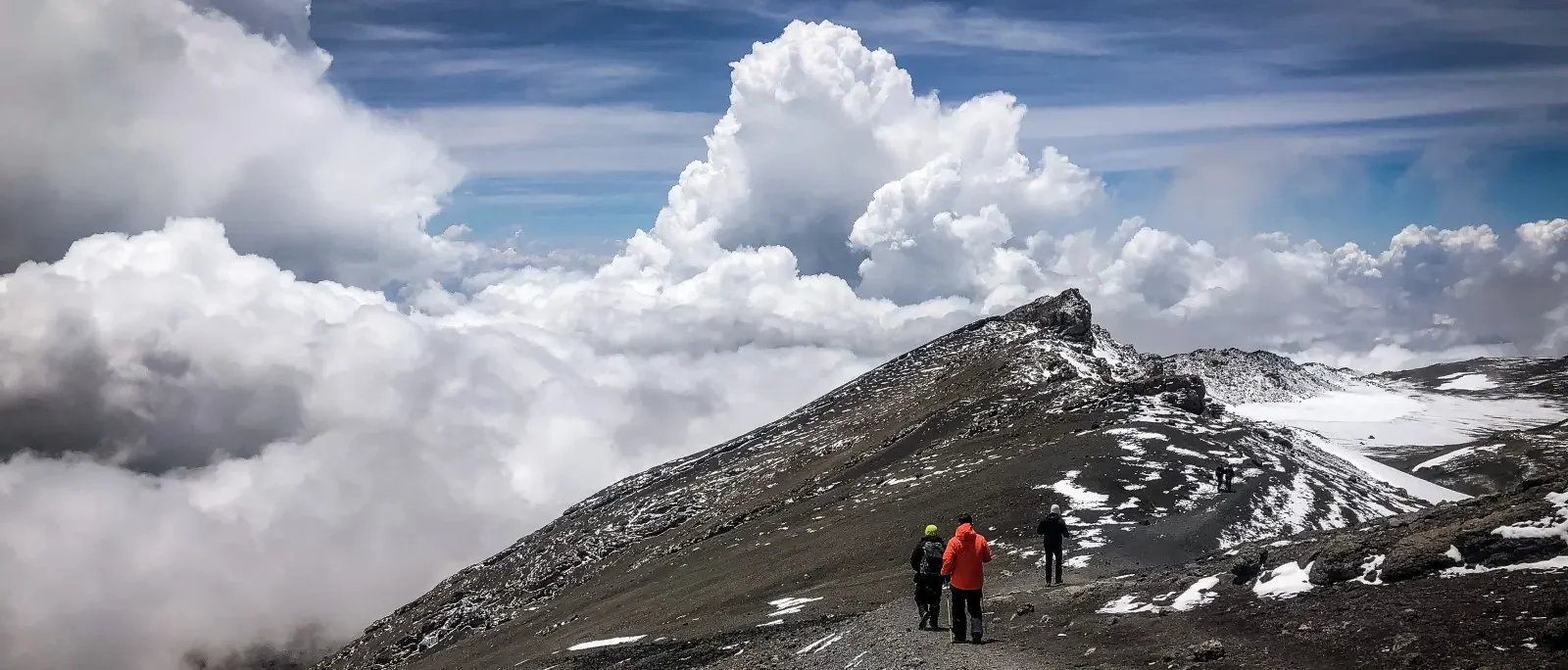
The environment becomes especially demanding during the final ascent towards the crater rim and Uhuru Peak. Climbers are exposed to cold temperatures, wind and increasingly thin air as they approach the summit at 5,895 metres.
The contrast with the lower mountain is remarkable. Within only a few days, hikers have travelled from cultivated foothills and tropical rainforest to a stark high-altitude landscape of rock, snow and ice.
At these elevations, reduced oxygen availability becomes increasingly important. A gradual itinerary, good acclimatization and a slow, controlled pace are essential parts of climbing Kilimanjaro safely.
What This Means for Climbers
How Kilimanjaro's Climate Zones Affect Your Hike
Climbing Kilimanjaro means preparing for several very different environments on the same trek. Conditions can change quickly as you gain altitude, so clothing, sun protection and waterproof layers need to remain easily accessible throughout the climb.
Rain Is Most Likely Lower Down
The rainforest is generally the dampest part of the mountain. Trails can become muddy after rain, so waterproof outer layers should be available from the beginning of the trek rather than packed deep inside your duffel.
Temperatures Fall as You Climb
Conditions become progressively cooler with altitude. Warm afternoons can still occur in exposed areas, but evenings and early mornings become much colder as you move through the moorland, alpine desert and summit zones.
Sun Exposure Becomes Stronger
Once the forest canopy disappears, hikers spend long periods in open terrain. Strong sunlight and increased ultraviolet exposure make sunscreen, sunglasses, a hat and protective clothing increasingly important.
Layering Becomes Essential
Kilimanjaro is not a mountain where one outfit works all day. Hikers regularly add or remove layers as temperatures, wind, cloud cover and exertion change. A flexible layering system is far more practical than relying on one heavy item of clothing.
The extreme cold near the summit often receives the most attention, but successful preparation also means being ready for rain, humidity, strong sun, wind and large temperature changes throughout the climb.
Different Sides of the Mountain
Do Kilimanjaro's Climate Zones Differ by Route?
All Kilimanjaro routes eventually climb through the same broad progression towards alpine desert and the arctic summit zone. The biggest differences occur lower on the mountain, where rainfall, vegetation and exposure vary between different slopes.
Lemosho Route
Lemosho begins on Kilimanjaro's western side and passes through a lush forest environment before emerging onto the open Shira Plateau. The route gives climbers a clear view of the transition from forest into heath, moorland and increasingly sparse high-altitude vegetation.
Western approachMachame Route
Machame approaches from the southern side of Kilimanjaro and begins in dense montane forest. As the route climbs higher, forest gives way to heath and moorland before the landscape becomes much drier and more exposed around the upper mountain.
Southern approachMarangu Route
Marangu climbs the eastern side of the mountain. The lower route passes through forest before continuing into open moorland around Horombo. Higher up, vegetation becomes sparse as the route approaches the broad alpine terrain leading towards Kibo.
Eastern approachRongai Route
Rongai approaches Kilimanjaro from the northern side, which is generally drier than the southern slopes. The vegetation can therefore feel more open in the lower sections before the route enters the same increasingly barren high-altitude environments found elsewhere.
Northern approachExact elevations vary with slope, rainfall and local conditions. Two climbers on different routes may therefore encounter the transition between forest, moorland and alpine terrain at slightly different elevations.
Frequently Asked Questions
Kilimanjaro Climate Zones FAQ
These are some of the most common questions about Kilimanjaro's climate, vegetation and ecological zones.
What are the five climate zones of Kilimanjaro?
Kilimanjaro is commonly divided into five broad ecological zones: the cultivation zone, montane rainforest, heath and moorland, alpine desert and the arctic summit zone. Climbers move through these environments as they gain altitude from the foothills towards Uhuru Peak at 5,895 metres.
What vegetation zones are found on Mount Kilimanjaro?
Vegetation changes dramatically with altitude. The lower slopes contain cultivated land and dense forest, followed by heath and moorland with grasses, heathers, giant groundsels and lobelias. Vegetation becomes increasingly sparse in the alpine desert and is virtually absent near the summit.
At what altitude does the rainforest end on Kilimanjaro?
The montane rainforest generally extends to around 2,800 metres, but there is no precise boundary. The transition into heath and moorland is gradual and can occur at slightly different elevations depending on the route, slope, rainfall and local conditions.
Why does Kilimanjaro have so many different climate zones?
Kilimanjaro rises from relatively warm lowlands to 5,895 metres above sea level. As elevation increases, temperature, rainfall, exposure and growing conditions change considerably. Differences in rainfall around the mountain's slopes also influence where particular types of vegetation thrive.
Which Kilimanjaro climate zone receives the most rain?
The montane rainforest is generally the wettest ecological zone on Kilimanjaro. Moist air and cloud frequently affect the lower forested slopes, although rainfall varies with season and with the side of the mountain.
Where do giant groundsels and lobelias grow on Kilimanjaro?
Giant groundsels and lobelias are most closely associated with Kilimanjaro's heath and moorland zone, broadly between about 2,800 and 4,000 metres. These unusual plants are adapted to strong sunlight, cold nights and large temperature changes at high elevation.
Is there vegetation at the summit of Kilimanjaro?
Vegetation is virtually absent in Kilimanjaro's highest arctic zone. Extreme cold, dryness, strong winds, intense exposure and the very high altitude make conditions unsuitable for most plant life.
Do all Kilimanjaro routes pass through the same climate zones?
Broadly, yes. Kilimanjaro routes move through the same general progression from lower vegetation zones towards alpine desert and the arctic summit environment. However, rainfall, vegetation density and the exact elevation of each transition can differ between the northern, southern, eastern and western sides of the mountain.
Climate zones explain how the mountain environment changes with altitude. For seasonal rainfall, temperatures and conditions throughout the year, see our Kilimanjaro Weather Guide .
Experience Kilimanjaro for Yourself
From Rainforest to Summit in One Extraordinary Climb
Kilimanjaro's changing landscapes are part of what makes the mountain so remarkable. Walk through rainforest, cross open moorland and alpine desert, then climb into the cold arctic environment of the summit. Explore our upcoming group climbs or contact us to start planning your Kilimanjaro adventure.